- Home
- Treatments
- Thai Yoga Stretching
Traditional Nuad Thai
Thai Yoga Stretching
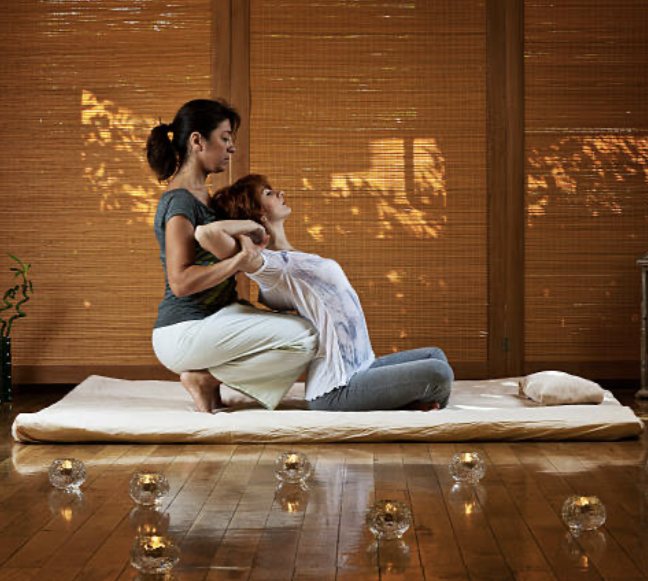
Assisted yoga stretches and acupressure along the body's energy lines, fully clothed and without oil. You relax. Your therapist does the moving.
60 min / $11990 min / $169120 min / $238
Fully clothed · No oil · Licensed MM 47569
- Duration60 · 90 · 120 minutes
- ClothingLoose and comfortable, stays on
- OilNone. A little Tiger Balm on tight spots
- Best forStiffness, mobility, desk-bound bodies
What It Is
The closest thing on our menu to Thai massage as Thailand practises it
No oil, no undressing, and very little lying still. In Thai Yoga Stretching your therapist uses palms, thumbs, forearms, elbows and carefully placed body weight to press along the body's sen lines, then moves you through slow, assisted stretches that look like yoga postures. You do none of the work. The pressing and rocking between the stretches is the part first-time guests do not expect, and the part they talk about afterwards.
This is Nuad Thai, which UNESCO added to its list of the Intangible Cultural Heritage of Humanity in 2019, calling it a "non-medicinal remedy and manual therapy" that grew out of village healers treating the aches of physical work. In the 1830s King Rama III had the knowledge carved into sixty stone tablets and eighty statues of stretching hermits at Wat Pho in Bangkok, where a school still teaches it. We practise it the way it was taught to us.
Why "yoga", and why "stretching"
The positions resemble yoga because they share roots, and Westerners have long called it "lazy person's yoga". The difference is that every stretch is passive and stays inside your comfortable range, so stiffness is a reason to come, not a reason to stay away. A light touch of Tiger Balm on the tightest spots adds warmth; we leave it out if you prefer.
What to Expect
Your session, start to finish
A traditional session moves from the feet upward and finishes at the shoulders, neck and head.
- Arrive dressed to move
Wear or bring loose, stretchy clothing: soft pants or shorts and a tee, nothing with a stiff waistband. Eat lightly in the hour or two before. On a first visit, come ten minutes early for a short health form.
- Talk it through
Injuries, surgeries, joint replacements, back trouble, blood pressure and how you feel about pressure. Your therapist plans the stretches around your body, not the other way round.
- The treatment
It begins at the feet and legs and works upward: slow palm and thumb pressure along the sen lines, rocking compression that lets muscles soften, then stretches for the hips, hamstrings, back and shoulders, with gentle cues to breathe out as a stretch deepens. It ends seated, with the neck, shoulders and head.
- Afterwards
Most guests stand up feeling looser and, in their words, a little taller. Have some water and take it gently. Mild soreness for a day or two, like the day after yoga, is normal.
60 minutes
$119
An efficient pass through the whole body, or a focus on the back, hips and legs. A good introduction.
90 minutes
$169
The length we recommend. Time for the full sequence in every position, a second pass on tight areas, and stretches held long enough to release rather than rushed. The best value per minute, too.
120 minutes
$238
Everything, twice. For very stiff bodies, athletes in a heavy training block, or a quarterly reset.
Why Guests Book It
Mobility first, calm close behind
Guests book it for how they move afterwards. They come back for how they feel.
- Looser hips, hamstrings and spineAssisted stretching reaches positions most of us cannot get to alone, and holds them calmly.
- Relief for desk-shaped bodiesNeck, shoulders and upper back carry the day. The sequence works through all of them.
- No oil, no shower, no fussWalk out dressed and go straight to dinner, back to work, or down to the beach.
- Relaxed and awakePeople describe the after-feel as rested but energised rather than sleepy.
What the research says, and what it doesn't
Traditional Thai massage has a real, if modest, research record, mostly small trials from Thai universities. Here is what it shows, and where it stops.
- A 2015 systematic review in Complementary Therapies in Clinical Practice (Keeratitanont et al.) found six studies of traditional Thai massage for chronic pain, all reporting pain reductions of 25 to 80 percent along with better flexibility and less anxiety. The studies were small and mostly uncontrolled.
- In a randomised trial of 36 people with back pain (Buttagat et al. 2011), a single 30-minute Thai massage improved heart-rate variability, pressure-pain threshold and flexibility compared with rest.
- A 2023 Khon Kaen University study of 33 office workers found that one 90-minute whole-body Thai massage reduced shoulder pain and improved neck movement and sit-and-reach scores, with no serious side effects. There was no control group.
- The Cochrane review of massage for low back pain (25 trials, 3,096 people) has "very little confidence" that massage is an effective treatment: benefits were short-term, there were no serious adverse events, and between 1.5 and 25 percent of people felt temporarily more sore.
We do not diagnose or treat medical conditions. If your pain is persistent, radiating or unexplained, see a doctor first. We are glad to work alongside your doctor's or physical therapist's plan.
Is It Right for You?
Who it suits
A good fit if you…
- You sit at a desk or behind a wheel all day and feel folded up
- You dislike oil, or want to go straight back to your day afterwards
- You would simply rather keep your clothes on
- You golf, run, paddleboard or play pickleball and want freer hips and hamstrings
- You find yoga hard, intimidating, or limited by an old injury
- You have just landed after a long flight or drive and want to be unfolded
- You are curious about traditional Thai massage and want the real thing
Check with your doctor first if…
- You are pregnant. We do not offer this treatment in pregnancy; see our Pre & Post Natal Treatment
- You have osteoporosis or fragile bones
- You have had surgery, a fracture, a joint replacement or spinal fusion in recent months
- You have a herniated disc, spinal stenosis or sciatica with numbness or weakness
- You have uncontrolled high blood pressure, heart disease, blood clots, or take blood thinners
- You are very hypermobile (tell us, and we will keep stretches conservative)
- You react to menthol or camphor (we will skip the balm)
- You have a fever, a skin infection, open wounds or sunburn
Tell us about anything on this list when you book. We can often adapt pressure, position or focus, and we will say so honestly if a different treatment, or a doctor first, is the better call.
Practical Notes
Before and after your session
Before you come
- Eat lightly an hour or two before; there is pressure through the abdomen and hips
- Wear loose, stretchy clothes. Leave belts, jeans and sharp jewellery at home
- Arrive ten minutes early on a first visit for the health form
- Tell us about injuries, surgeries, joint replacements and medications
Afterwards
- Drink some water and move gently; a slow walk along the water is ideal
- A warm shower or bath that evening helps muscles settle
- Skip hard training for the rest of the day
- Mild soreness for 24 to 48 hours is normal. Call us if anything feels sharp or lasts longer
How often? Many guests start with two or three sessions a week or two apart, then settle into every three to six weeks. Monthly is a sensible rhythm for a desk-bound body.
Questions Guests Ask
Good to know
Do I have to undress?
No. You stay fully clothed the whole time, and no oil or lotion is used.
What should I wear?
Soft, stretchy clothing you could do yoga in: leggings or shorts and a loose top. Avoid jeans, belts and anything with a stiff waistband.
Does it hurt?
It can feel intense, because of the compression and the stretching, but it should not hurt in a bad way. A tight muscle releasing feels quite different from pain that feels wrong. Say "lighter" and your therapist eases off immediately.
Is it the same as a yoga class?
The positions look like yoga, but you do none of the work; the therapist moves you, so positions become available even to stiff bodies. It is bodywork, not exercise, and not a replacement for yoga.
Will someone walk on my back?
Traditional Thai massage can use the feet and body weight. Our therapists mainly work with palms, thumbs, forearms and elbows, with controlled body weight for depth, and nothing is done that you are not comfortable with. Tell us at the start what you would rather we skipped.
I am very stiff. Is that a problem?
It is the reason most guests come. Every stretch stays inside your comfortable range, and the range tends to grow over a few visits.
How is it different from Thai Combination?
Thai Combination is an oil massage on the table that includes Thai stretching and acupressure alongside flowing and deep-tissue strokes. Thai Yoga Stretching is clothed and oil-free, with far more stretching and pressing along the sen lines. Choose this one when mobility matters most.
Why do you recommend 90 minutes?
The full sequence covers you lying on your back, side and front and finishes seated. Ninety minutes allows that whole cycle plus a second pass on tight areas, with stretches held long enough to release. Sixty is a fine introduction; ninety is also the best value per minute.
What is the balm?
A small amount of Tiger Balm, a traditional Thai-style herbal balm containing camphor and menthol, applied to the tightest spots for warmth. It is easy to leave out; just tell us if you have sensitive skin or dislike the scent.
Can I have this while pregnant?
Not this treatment. The compression and stretching routines are not suited to pregnancy. Our Pre & Post Natal Treatment is designed for exactly that.
I have a bad back, a disc problem or osteoporosis. Is it safe?
Ask your doctor first and tell us at intake. We can leave out spinal twists and deep pressure and keep stretches conservative, but we cannot diagnose or treat a medical condition, and for some backs a gentler treatment is the better choice.
Will I be sore afterwards?
Possibly a little, for a day or two, much like after a good yoga class. Water, a warm shower and gentle movement help.
Is it religious?
It is rooted in Thai Buddhist healing tradition, and many therapists pause for a quiet moment of respect to their teachers before they begin. Nothing is asked of you.
“…If the pressure was ever too much, I only had to mention it once to Annie and she adjusted. If you have never had a Thai massage before, this is the place to try it out!”
Reserve Your Time
Unfold. Lengthen. Breathe.
Book 90 minutes and arrive in something comfortable. Walk-ins are welcome whenever a therapist is free; booking ahead guarantees your time.
Massage therapy is for relaxation and wellness. It is not a substitute for medical diagnosis or treatment. Please consult a qualified healthcare professional for persistent, severe or unexplained symptoms.